Newsletter Subscribe
Enter your email address below and subscribe to our newsletter
Enter your email address below and subscribe to our newsletter

 ByJohn A
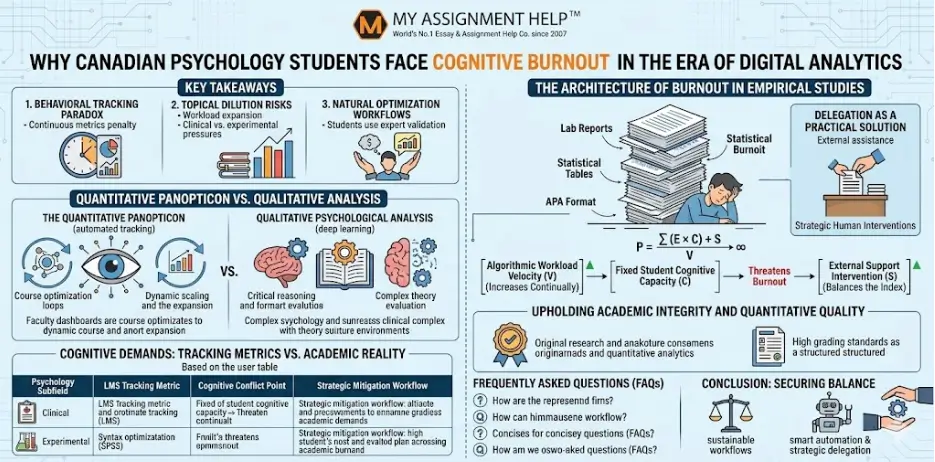
The Canadian post-secondary ecosystem in 2026 is governed by pervasive, real-time data tracking. For undergraduate and postgraduate students across institutions like the University of Toronto, UBC, and McGill, the traditional academic calendar—once defined by predictable midterm exams and final essays—has been replaced by continuous behavioral evaluation. Institutional Learning Management Systems (LMS) now run sophisticated behavioral analytics that monitor reading speeds, forum interactions, and digital resource engagement frequencies.
While these automated tracking frameworks are applied universally across campus departments, their impact is particularly disruptive within the behavioral and clinical sciences. Psychology curricula demand deep qualitative analysis, extensive literature reviews, and methodical empirical validation. Forcing these reflective learning styles into rigid, algorithmically tracked timelines has triggered an unprecedented wave of mental fatigue among students. When daily digital interactions are constantly evaluated by automated systems, the space required for genuine intellectual exploration disappears.
The operational velocity of modern courses means that missing a single tracking window can lower a student’s predictive performance score. This is especially true when compiling multi-layered research papers, handling statistical SPSS data, or drafting behavioral case reviews under strict deadlines. Because these metrics leave little room for error, many students are turning to specialized academic networks for tailored psychology assignment help in Canada to bridge the gap between strict analytical monitoring and deep mental reflection. Without these strategic human interventions, modern learners face compounding metric penalties that do not accurately reflect their actual comprehension of the material.
The core problem with modern academic tracking is its focus on quantitative metrics over qualitative depth. Faculty members routinely use real-time dashboards to adjust the pacing of their courses based on aggregate cohort analytics. If the system shows that a group processed a module on cognitive development quickly, subsequent assignments on neuroanatomy or behavioral research methods are automatically expanded in scope.
This dynamic scaling creates an intense optimization loop. For a psychology student, true mastery of a concept requires analyzing conflicting clinical theories and evaluating historical experimental biases. These processes take time and cannot be accurately measured by how fast a student clicks through online slides. When the system prioritizes fast interaction over deep understanding, it creates an environment where students must manage their metrics rather than focus on real learning.
| Psychology Subfield | Specific LMS Tracking Metric | Cognitive Conflict Point | Strategic Mitigation Workflow |
| Clinical Case Analysis | Page-dwell time & micro-quiz velocity | Fast metrics penalize patient file review and deep clinical reasoning. | Outsource administrative formatting to focus on diagnostic analysis. |
| Experimental Design | Repository download intervals | Systems mistake deliberate data analysis for lack of student progress. | Use verified external networks to double-check statistical calculations. |
| Statistical Methods (SPSS) | Continuous syntax submission tracking | Rigid coding timelines ignore the trial-and-error nature of data analysis. | Delegate foundational code writing to preserve time for analyzing results. |
Compiling comprehensive laboratory reports presents a major academic challenge for psychology undergraduates. Unlike general humanities essays, a rigorous psychological report requires precise methodology sections, complex statistical tables, and detailed APA-formatted citations. When these demanding requirements are combined with a continuous assessment schedule, the total workload often exceeds what a student can reasonably sustain.
This systematic pressure explains why the modern student workflow has shifted toward professional delegation. When a student faces multiple overlapping technical deadlines across advanced statistics and experimental psychology courses, they often look for external ways to distribute the workload. In these high-pressure situations, choosing to pay to do my assignment modules becomes a practical way for students to handle complex data requirements while maintaining their mental well-being and academic standing. Delegating foundational data structuring allows students to protect their focus for the core interpretive analysis that university grading panels prioritize.
The challenge of balancing academic performance with available time can be explained using a practical efficiency formula. Let the total student performance index be defined as P, which depends on active study effort E, cognitive capacity C, and external support intervention S, divided by the algorithmically accelerated workload velocity V:
P = \frac{\sum (E \times C) + S \rightarrow \infty}{V}
As universities use automated tracking to increase workload velocity (V), maintaining a strong performance index (P) requires either expanding study effort (E) to an unsustainable degree or integrating external support systems (S). Since baseline human cognitive capacity (C) is naturally limited, utilizing specialized academic assistance is a practical necessity for students navigating highly demanding educational tracking systems.
[ Algorithmic Workload Velocity (V) ] ▲ (Increases Continually)
│
▼
[ Fixed Student Cognitive Capacity (C) ] ──► Threatens Burnout
│
▼
[ External Support Intervention (S) ] ▲ (Balances the Index)
As external support networks become more common, maintaining high standards of original research remains essential. Using specialized academic assistance is not about bypassing the learning process; rather, it provides students with clear, well-structured reference models that meet rigorous Canadian grading rubrics.
A thoroughly researched reference report helps clarify complex concepts, like advanced statistical methods or behavioral models. By studying the structure and evidence in an expert document, students can deepen their understanding and more effectively build their own original analysis. This collaborative approach ensures that final submissions meet high academic standards while fully respecting institutional guidelines around integrity.
The rise of predictive analytics and continuous tracking has fundamentally changed the experience of studying psychology at Canadian universities. While these digital systems present new challenges to traditional study habits, they also encourage students to build highly efficient workflows. By combining smart automation, strategic delegation, and professional academic support, students can successfully manage intense course demands. Succeeding in 2026 requires finding a sustainable balance between modern educational tracking tools and proven, deep learning strategies.
See also: The Rise of Sustainable Digital Systems
LMS tracking systems measure fast, continuous online activity, which conflicts with the long periods of quiet reading and careful data analysis required to evaluate complex behavioral theories and clinical studies.
When algorithms show that a cohort processes basic introductory reading quickly, the system automatically prompts instructors to add more reading and complex assignments to the schedule, leading to continuous workload inflation.
External services can handle time-consuming tasks like formatting citations, structuring reference bibliographies, and organizing raw data, allowing students to focus their energy on interpreting results and understanding core concepts.
Yes, modern Canadian institutions use advanced detection engines that analyze sentence structure and vocabulary patterns. This makes original, human-authored content from trusted academic platforms essential for meeting institutional standards.
Marcus Henderson – Senior Content Strategist & Academic Scholar, MyAssignmentHelp
Marcus Henderson is an educational researcher and digital content analyst specializing in post-secondary learning systems across North America. With over nine years of experience documenting academic workplace trends, his data-driven insights help modern university students optimize their workflows and maintain high performance in technology-driven environments.